
Canada Stuns USA as First Olympic Spots Are Set
Canada's women beat the United States 27-20 in Dusseldorf to take their first world title since 2014, the United States men held off Italy 46-26 for a sixth straight crown, and four nations walked away with the first quota places for flag football's Olympic debut at Los Angeles 2028.
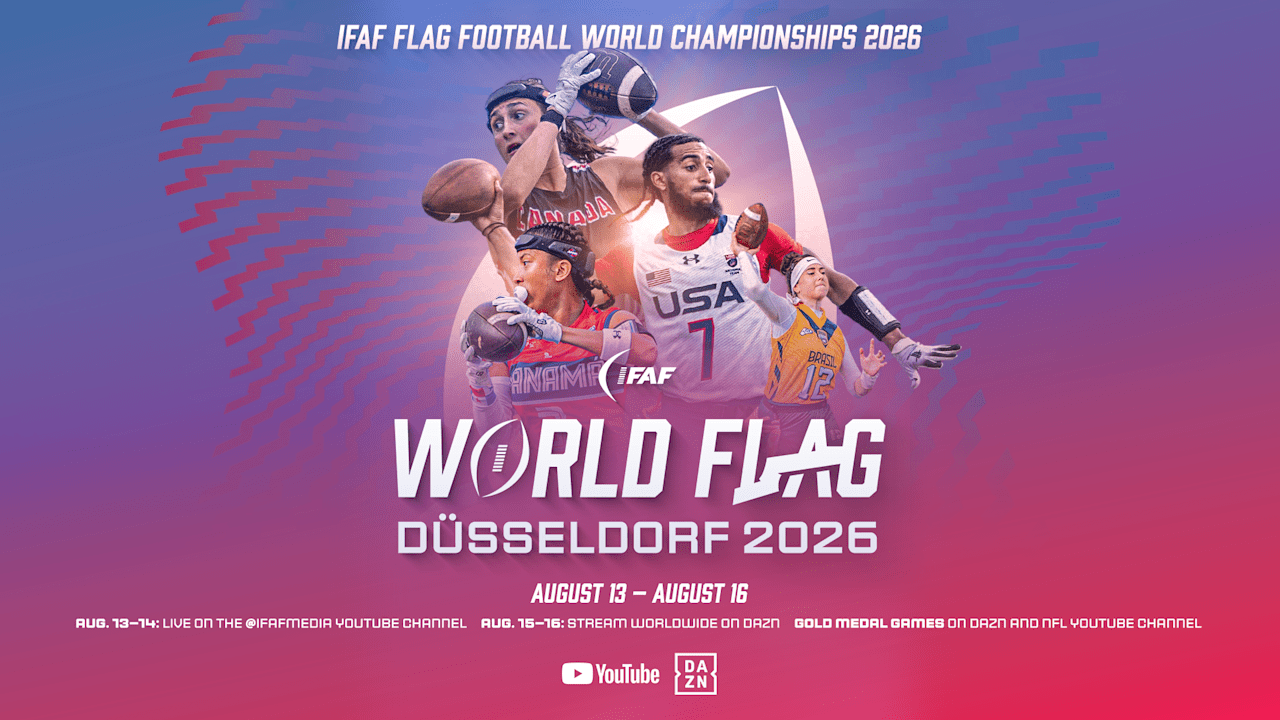
Flag football's first Olympic qualifier was staged at the IFAF Flag Football World Championships in Dusseldorf, Germany, from August 13 to 16, 2026. (NFL)
At a Glance
- Canada's women beat the United States 27-20 on August 16 in Dusseldorf to end a 12-year wait for a world title, while the United States men beat Italy 46-26 for a sixth consecutive championship.
- The tournament doubled as flag football's first Olympic qualifier, sending the United States, Canada and Italy in the men's draw and the United States, Canada and Mexico in the women's draw to Los Angeles 2028.
- Three of the six places in each Olympic field remain open and will be decided through the 2027 continental championships and a final qualifier in 2028.
The 2026 IFAF Flag Football World Championships closed on August 16 in Dusseldorf, Germany, with two finals that pulled in opposite directions for the United States. The men rolled past Italy 46-26 for a sixth consecutive world title. Ninety minutes of tournament drama later, the women lost 27-20 to Canada, surrendering a crown they had held since 2014 and handing the neighbors to the north a result that will define Canadian flag football for the next two years.
The stakes went well beyond medals. Dusseldorf was the first Olympic qualifying event in the sport's history, and the placings converted directly into quota places for the Los Angeles 2028 Games, where flag football makes its Olympic debut with six teams in each draw.
The Finals
The women's final was level at 14-14 at the break before Canada found the separation it needed in the second half, with quarterback Sara Parker connecting with Frederique Morneau on the drive that swung the game. The United States had one last fourth-down snap with three seconds on the clock and could not convert. Parker, who was named the tournament's most valuable player, called it "literally the best day ever" afterward.
The men's final never carried the same tension. Nico Casares threw two touchdown passes as the United States pulled clear of an Italy side that had already secured its Olympic place by reaching the final. "Gold is the only standard," Casares said. "That's our motto. That's what we play by, that's what we live by." Darrell Doucette, the long-time face of the United States men's program, took the men's most valuable player award.
Who Is Going to Los Angeles
The qualification math is straightforward and unusually generous to North America. The United States holds an automatic berth in both draws as the host nation, which meant the top two finishers in Dusseldorf outside the United States claimed the remaining places on offer. In the men's tournament that produced Italy, the beaten finalist, and Canada, which came through a 34-26 overtime win against Mexico in the bronze game. In the women's tournament it produced Canada as champion and Mexico, which edged Great Britain 20-19 in a bronze final that Great Britain led by fourteen points at one stage.
Great Britain's women were the story of the wrong side of the ledger, missing an Olympic place by a single point after building a 20-6 advantage. Their route to Los Angeles now runs through the 2027 European championship and the 2028 qualifier series.
What Dusseldorf Proved
IFAF reported roughly 20,000 spectators across the four days at the Garath complex, a broadcast footprint reaching approximately 180 million potential viewers through the federation's global agreement with DAZN, and more than 42 percent of games decided by a single score. Pierre Trochet, the IFAF president, said "Dusseldorf 2026 has truly set a new benchmark for an international flag football event." The championships also served as the launch point for IFAF's new multi-year performance apparel partnership with Nike, announced on August 6, which put Nike's name on both most valuable player awards.
More than 300 athletes from 18 countries competed, the largest field the sport has assembled at a senior world championship, and the competitive spread underneath the medalists was the most encouraging detail. Panama, Nigeria, Japan and Australia all arrived with credible programs, which is a different picture from the two-nation rivalry that defined the discipline a decade ago.
The Road Still Open
Half of each Olympic field is still unclaimed. The 2027 continental championships across Africa, the Americas, Asia, Europe and Oceania will send the top two men's and women's teams from each continent, excluding those already qualified, into an Olympic qualifier series in the spring or summer of 2028. Ten teams per gender will contest the final three places in each draw at that event.
For the United States women, the more immediate question is what happens between now and then. The program has not lost a world final since 2014 and now has roughly 22 months to rebuild toward a home Olympics where it will be the favorite by reputation rather than by recent result. Canada, which has spent the last two years formalizing a national pathway from provincial programs upward, arrives in Los Angeles as the reigning world champion in the women's draw and a bronze medalist in the men's. That is the strongest position any nation outside the United States has ever held in this sport.